
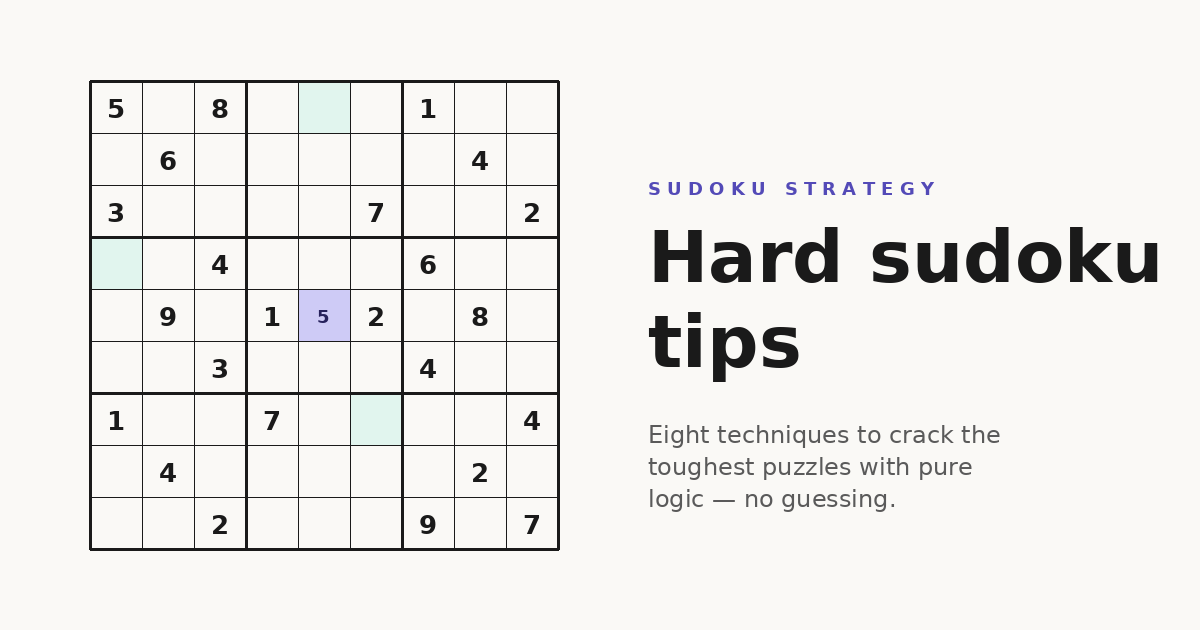
Easy and medium sudoku puzzles can usually be solved with basic scanning and elimination. Hard and expert puzzles are different. At some point the simple techniques stop working and you need a more systematic approach. These advanced tips will help you break through the toughest grids using nothing but logic.
Why Hard Puzzles Feel Impossible
Hard and expert sudoku puzzles are designed with fewer starting numbers. This means fewer easy deductions early on, and a grid that stays uncertain for longer. Basic techniques like looking for cells with only one candidate become less useful when most cells have three or four candidates each.
The solution is not to guess. Guessing introduces errors that can derail an entire puzzle and takes away the satisfaction of a clean logical solve. Every hard and expert puzzle on this site is solvable using pure logic — you just need the right tools. This isn’t marketing — it’s a mathematically proven property of valid sudoku puzzles, which by definition have exactly one solution reachable through deduction alone.
Tip 1 — Always Fill Naked Singles First
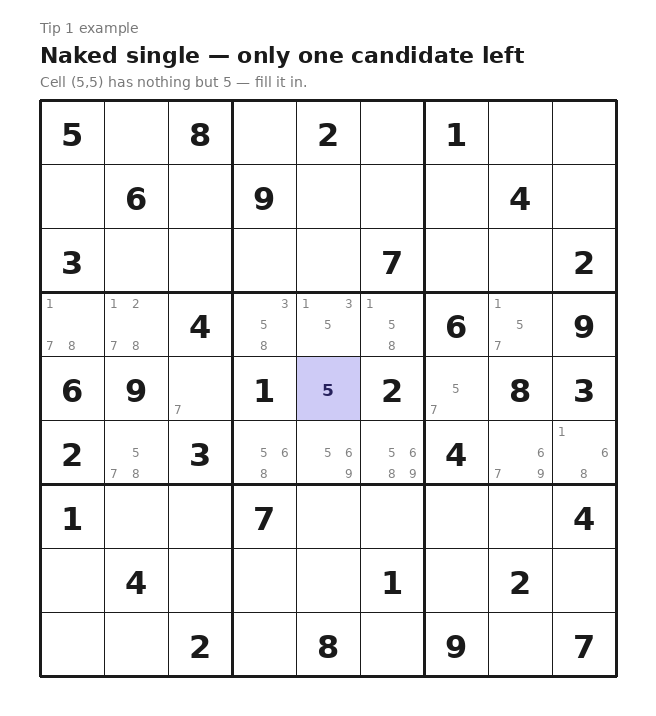
Before attempting anything advanced, sweep the entire grid for naked singles. A naked single is a cell with only one candidate remaining. Fill it in, then sweep again. Filling one cell often reduces candidates in other cells, sometimes creating new naked singles.
Never move to advanced techniques until you have exhausted all naked singles. This is the fastest way to make progress and the most common mistake players make — jumping to complex techniques when simpler ones still have moves available.
Tip 2 — Find Hidden Singles Before Moving On
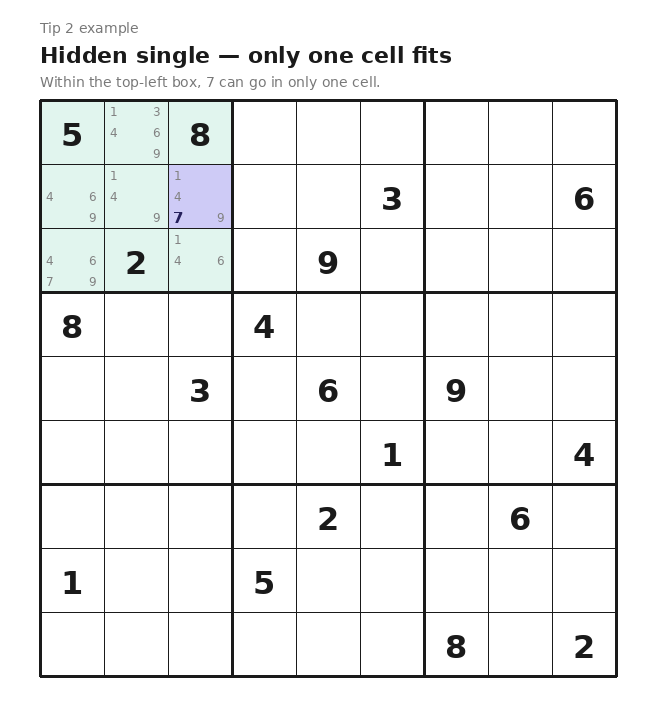
After naked singles, look for hidden singles. A hidden single is a number that can only go in one cell within a row, column, or box — even if that cell has multiple candidates.
Scan each unit for numbers that have not been placed yet. For each number, check how many cells in that unit can still hold it. If only one cell is possible, place the number. This is hidden singles.
Like naked singles, hidden singles should be exhausted before moving to any technique beyond this level. Most medium puzzles and many hard puzzles can be completed with just these two techniques combined.
Tip 3 — Use Candidate Tracking Properly
At hard difficulty, solving without candidate tracking is extremely difficult. Use the notes feature in the online puzzle or write small pencil marks in each cell showing which numbers are still possible.
The key is keeping your notes accurate. Every time you place a number, immediately remove it as a candidate from every other cell in the same row, column, and box. Stale notes — candidates that are no longer valid but have not been crossed out — are the most common source of errors.
Start a hard puzzle by filling in all candidates for every empty cell. Then work through naked singles and hidden singles, updating candidates as you go. A clean candidate grid makes advanced techniques far easier to apply.
Tip 4 — Apply Box-Line Reduction
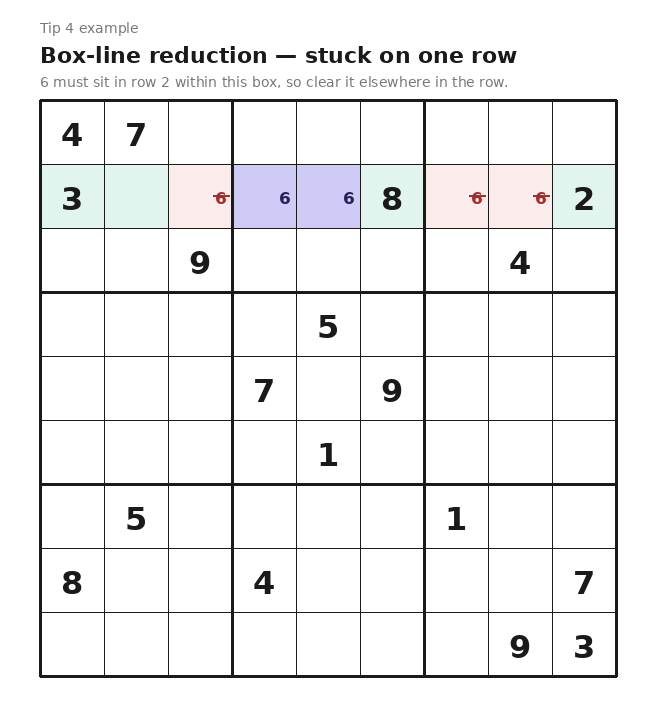
Box-line reduction — also called pointing pairs or claiming — is a technique that bridges boxes and lines.
If a candidate appears in only one row (or column) within a 3×3 box, then that candidate must go somewhere in that row within the box. This means you can eliminate it from the rest of that row outside the box.
Similarly, if a candidate in a row only appears in cells that all belong to the same 3×3 box, you can eliminate it from the rest of that box.
This technique is available on most hard puzzles and is often overlooked. Scan each box and check whether any remaining candidates are confined to a single row or column within that box.
Tip 5 — Look for Naked and Hidden Pairs
When box-line reduction has been exhausted, look for pairs. A naked pair is two cells in the same unit that each contain exactly the same two candidates. A hidden pair is two numbers that only appear in the same two cells within a unit, even though those cells have other candidates too.
Both types of pairs let you eliminate candidates. Naked pairs eliminate those two numbers from other cells in the unit. Hidden pairs eliminate all other candidates from the two cells involved.
Finding pairs often unlocks a cascade of simpler moves. After applying a pair, always go back to sweeping for naked singles and hidden singles before looking for more pairs.
Tip 6 — When to Try X-Wing
If pairs have been applied and the puzzle is still stuck, it is time to look for X-Wing patterns. X-Wing applies when a candidate appears in exactly two cells in each of two rows, and those cells align in the same two columns. You can then eliminate that candidate from all other cells in those two columns.
X-Wing requires careful scanning. Work through each unplaced number systematically, row by row, looking for rows where that number appears in exactly two cells. When you find two such rows with the same two columns, you have an X-Wing.
Tip 7 — Work Methodically, Not Randomly
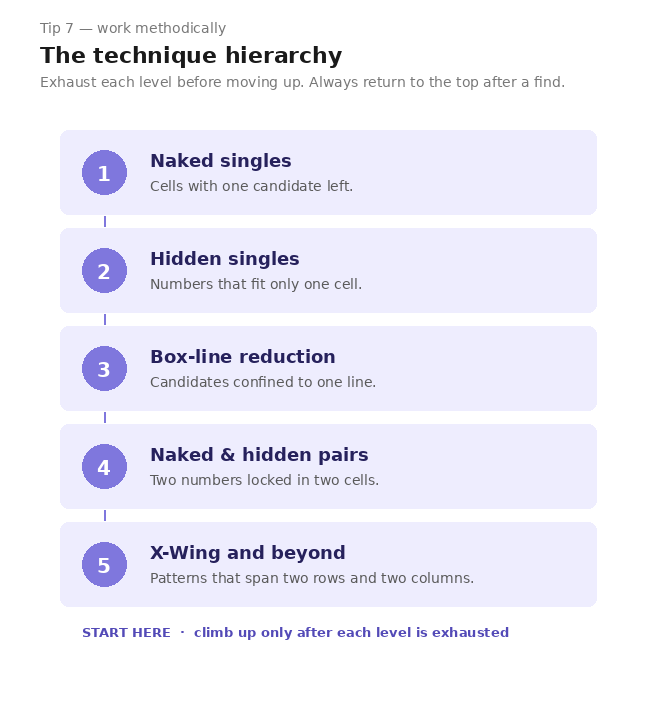
The biggest difference between players who solve hard puzzles consistently and those who get stuck is methodology. Effective solvers work through a hierarchy of techniques in order, exhausting each level before moving to the next:
- Naked singles
- Hidden singles
- Box-line reduction
- Naked and hidden pairs
- X-Wing and advanced patterns
Each level takes a pass through the grid. After applying anything from levels 3-5, always return to level 1 and sweep for naked singles again before continuing.
This systematic approach prevents you from missing simple moves while hunting for complex ones.
Tip 8 — Take Breaks on Expert Puzzles
Expert puzzles can require sustained concentration across many technique applications. If you have been staring at a grid for a while and feel stuck, take a short break and come back with fresh eyes. Patterns that were invisible often become obvious after a few minutes away.
This is not a solving technique — it is just practical advice. The grid has not changed. Your perception of it has.
Try a hard sudoku puzzle and apply these techniques from the start. If you are ready for the ultimate challenge, expert difficulty will push every technique to its limit. For specific advanced techniques, read about X-Wing and hidden pairs. Browse everything in the sudoku strategies guide.