
No. A properly constructed sudoku puzzle never requires guessing. Every puzzle has exactly one solution, and that solution can always be reached through pure logical deduction. If you feel like you need to guess, it means there is a technique you have not applied yet — not that the puzzle requires it.
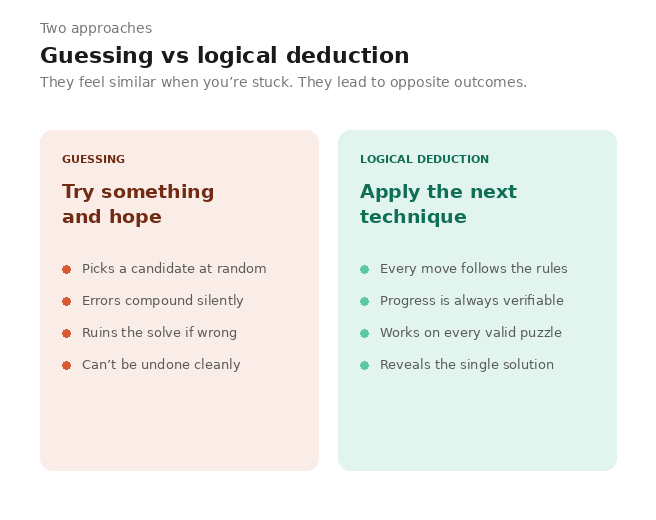
This is one of the most common misconceptions about sudoku, and it holds many players back from solving harder difficulties. This guide explains why guessing is never necessary, what to do instead, and how to get unstuck when the puzzle feels impossible.
Why People Think They Have to Guess
The feeling that guessing is necessary usually comes from one of two situations.
The first is running out of obvious moves. Basic scanning stops working, no cells have only one candidate, and the puzzle appears frozen. The natural human instinct is to try something and see if it works. This is guessing, and it will often lead you into errors that are difficult to undo.
The second is not knowing that advanced techniques exist. Easy and medium puzzles can be solved with simple scanning and elimination. Hard and expert puzzles require techniques like pointing pairs, naked pairs, hidden pairs, X-Wing, and others. If you do not know these techniques exist, you will inevitably reach a point where no move seems available — not because the puzzle requires guessing, but because the next step requires a tool you have not learned yet.
What Every Properly Made Sudoku Guarantees
A legitimate sudoku puzzle has two guaranteed properties. First, it has exactly one solution. Second, it can be solved using logical deduction without guessing. These are not optional features — they are the definition of a valid sudoku puzzle. In fact, mathematicians at University College Dublin formally proved in 2012 that a sudoku requires a minimum of 17 starting clues to guarantee a unique solution — reinforcing that properly constructed puzzles are mathematically bound to have one logical path to that solution.
Every puzzle on this site is generated and verified to meet both requirements. If you reach a point where no move seems obvious, the puzzle is solvable and a logical path forward exists. The question is which technique reveals it.
What to Do Instead of Guessing
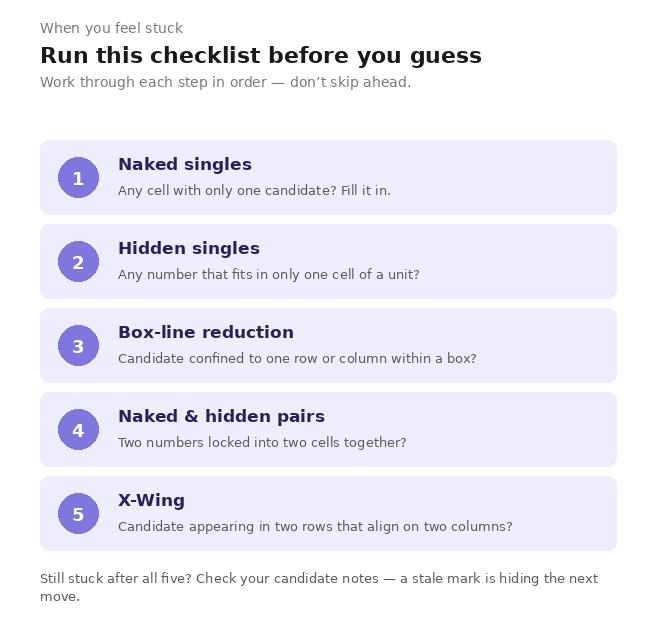
When you feel stuck, work through this sequence before considering any other option.
Check for naked singles. A naked single is a cell with only one candidate remaining. Scan every empty cell. If any has exactly one candidate, fill it in. Then scan again — filling one cell often creates new naked singles.
Check for hidden singles. A hidden single is a number that can only go in one cell within a row, column, or box — even if that cell has other candidates. For each unplaced number in a unit, check how many cells can still hold it. If only one, place it.
Check for box-line reduction. If a candidate only appears in one row or column within a 3×3 box, you can eliminate it from the rest of that row or column outside the box.
Look for naked pairs and hidden pairs. If two cells in the same unit share exactly the same two candidates, those two numbers must go in those two cells — eliminate them from other cells in the unit. If two numbers only appear in the same two cells within a unit, eliminate all other candidates from those cells.
Try X-Wing. If a candidate appears in exactly two cells in each of two rows, and those cells align in the same two columns, you can eliminate that candidate from all other cells in those columns.
If you have genuinely worked through all of these techniques and the puzzle is still stuck, the issue is likely a missed candidate or an error made earlier — not that guessing is required.
What About Bifurcation?
Some advanced solvers use a technique called bifurcation, sometimes called “trial and error” or “what if” analysis. This involves choosing a cell with two candidates, assuming one is correct, and following the logical consequences to see if a contradiction arises.
Bifurcation is not the same as random guessing. It is a structured logical process. But it is also controversial in the sudoku community — many purists argue that a well-constructed puzzle should not require it, and that if you need bifurcation, you have missed a logical technique somewhere.
For most puzzles, including all puzzles on this site, bifurcation is never necessary. The puzzles are constructed to be solvable through straightforward application of known techniques.
How to Use Candidate Tracking to Avoid Dead Ends
The most important practical step for avoiding the need to guess is accurate candidate tracking. If you know exactly which numbers are possible in every cell at every stage of the solve, the logical path forward is always visible — even if it requires an advanced technique to see it.
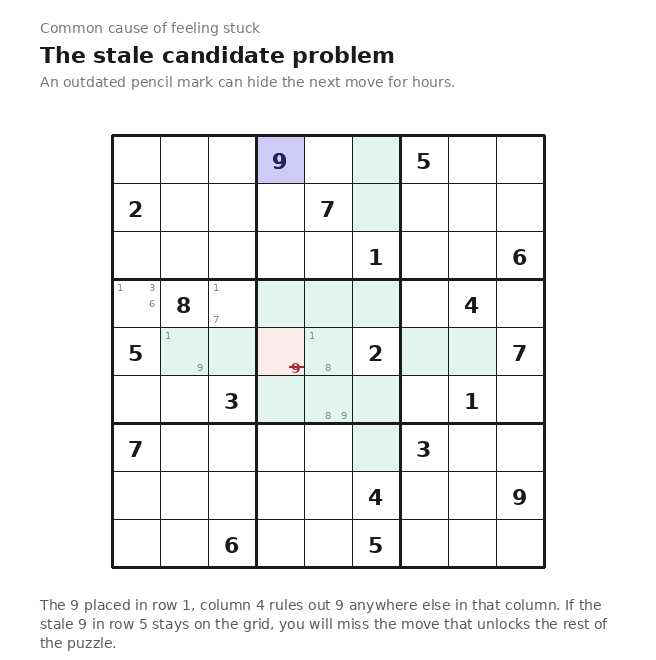
Use the notes feature in the online puzzle or pencil marks on paper. At the start of a hard puzzle, fill in all candidates for every empty cell. Then eliminate candidates as you make placements and apply techniques. Keep your notes completely up to date.
Errors in candidate tracking — cells that still show a number as a candidate after it has been placed in the same row, column, or box — are the most common reason experienced players get stuck unnecessarily.
When You Are Genuinely Stuck
If you have applied every technique you know and the puzzle is still frozen, the most productive things to do are:
Take a break. Return after a few minutes and look at the grid with fresh eyes. Patterns that were invisible often become obvious after a short rest.
Check your candidates. Go through each placed number and verify that it has been eliminated as a candidate from every cell in the same row, column, and box. A single stale candidate can hide the next move.
Learn the next technique. If you are consistently getting stuck at the same point, it probably means the puzzle requires a technique you have not learned yet. Our sudoku strategies guide covers every major technique in order of difficulty.
Try a medium sudoku puzzle and practise solving without guessing. When you are ready for a bigger challenge, hard difficulty will require the techniques covered in this guide. For more on specific advanced strategies, read about X-Wing and hidden pairs. And if you are still learning the basics, the how to play guide is a great starting point.