
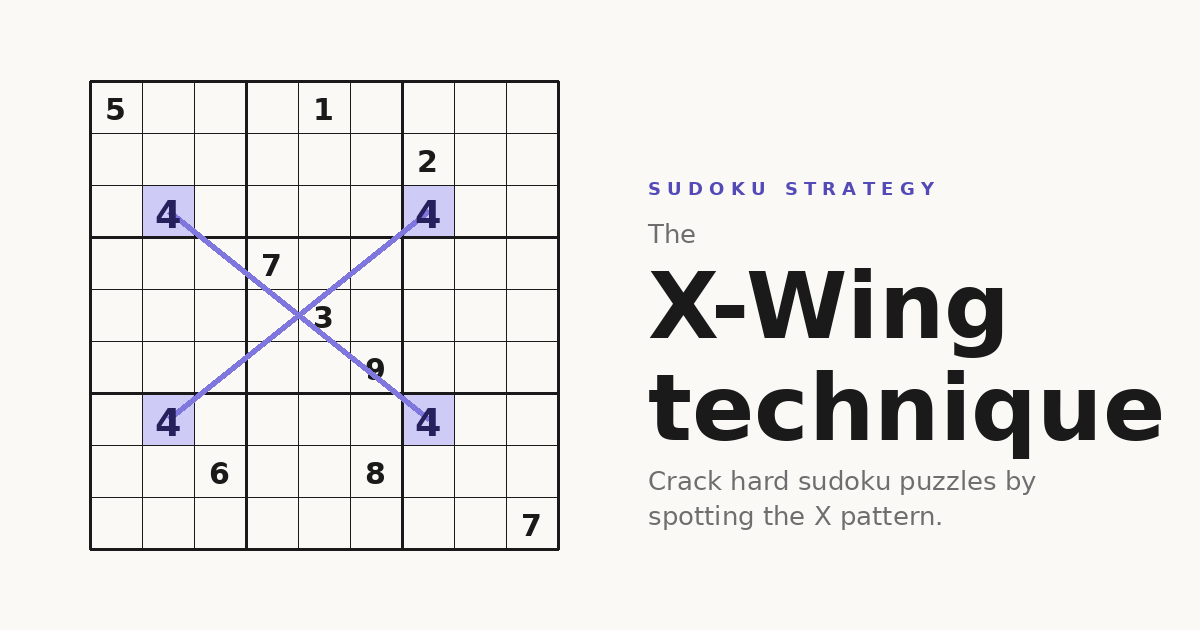
If you have worked through easy and medium puzzles without much trouble but keep hitting a wall on hard difficulty, the X-Wing technique is probably the missing piece. It sounds intimidating but the logic behind it is clean and satisfying once you see it. This guide explains exactly what X-Wing is, when to use it, and how to apply it step by step.
What Is the X-Wing Strategy?
X-Wing is a candidate elimination technique used in hard and expert sudoku puzzles. It works by identifying a specific pattern across the grid that forces a number to appear in certain positions — which in turn lets you eliminate that number as a candidate from other cells.
The name comes from the shape the pattern makes on the grid. When you draw lines connecting the four cells involved, they form an X — two rows crossing two columns, like the wings of an X-wing fighter.
When Do You Need X-Wing?
You need X-Wing when basic techniques — naked singles, hidden singles, pointing pairs — have stopped working and you cannot make any further progress. This typically happens on hard and expert puzzles where the grid has been reduced to a state where every remaining empty cell has two or more candidates and no obvious next move is available.
If you have filled in all the naked singles and hidden singles you can find and the puzzle is still stuck, it is time to look for advanced patterns like X-Wing.
How X-Wing Works — The Logic
X-Wing applies when a specific candidate number appears in exactly two cells in each of two different rows, and those cells align in exactly the same two columns.
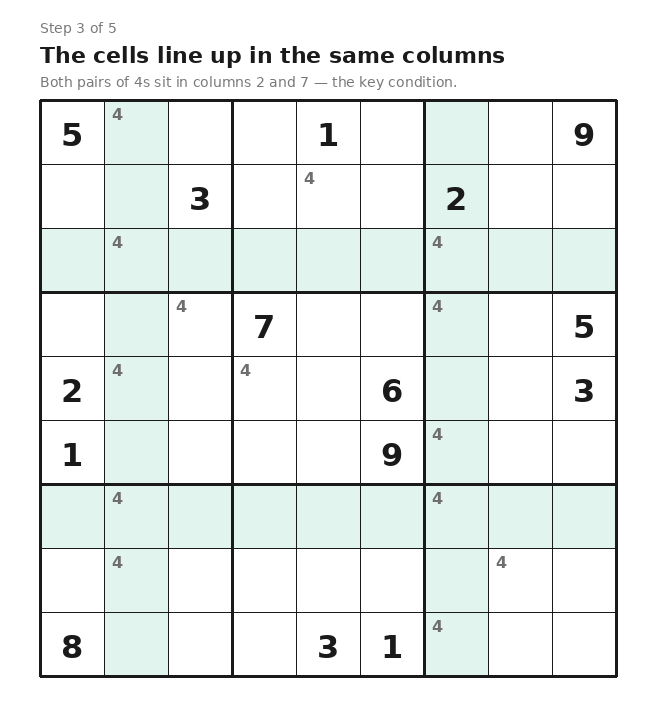
Here is the reasoning. If a number appears in only two cells in row 3 — say columns 2 and 7 — then that number must go in one of those two cells. It cannot go anywhere else in row 3. Now if the same number also appears in only two cells in row 7, and those cells are also in columns 2 and 7, you have an X-Wing pattern.
The logic works like this. The number must appear once in row 3, either in column 2 or column 7. It must also appear once in row 7, either in column 2 or column 7. Because both columns are shared between both rows, the number must appear exactly once in column 2 and exactly once in column 7 across the entire puzzle. This means you can safely eliminate that number from every other cell in columns 2 and 7 outside of rows 3 and 7.
Step by Step Example
Step 1. Pick a candidate number — say the number 4 — and mark all the cells where 4 is still a possibility.
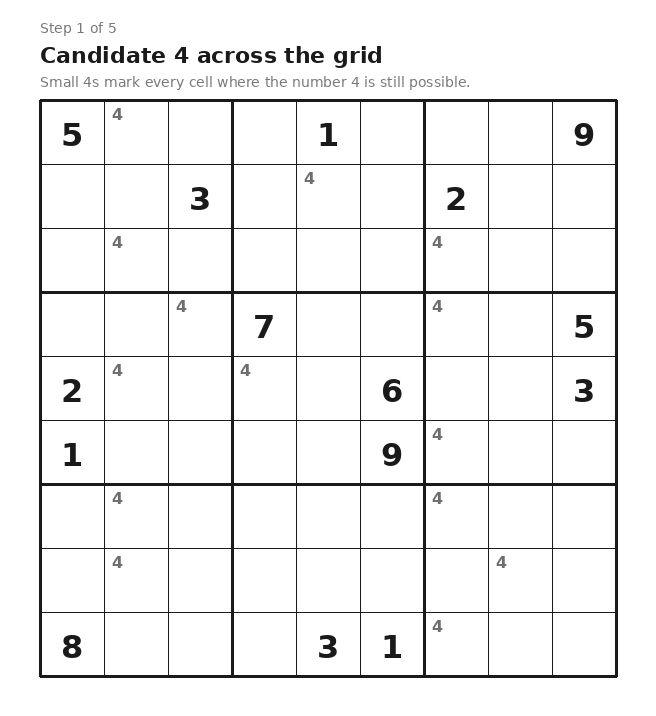
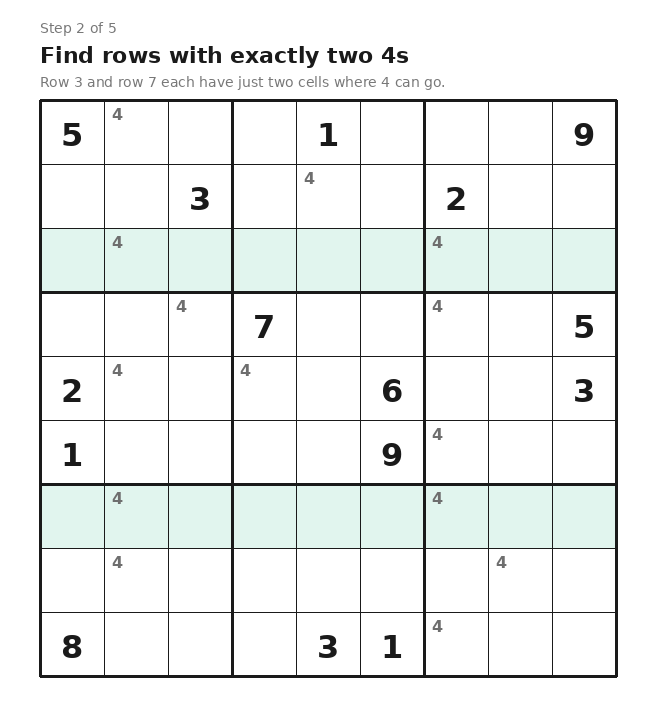
Step 2. Look at each row and find rows where 4 appears as a candidate in exactly two cells. Write down which columns those cells are in.
Step 3. Find two rows where 4 appears in exactly two cells AND those cells are in the same two columns. This is your X-Wing.
Step 4. Eliminate 4 as a candidate from all other cells in those two columns. Any cell in column 2 or column 7 that is not in row 3 or row 7 cannot contain the number 4 — you can cross it out.
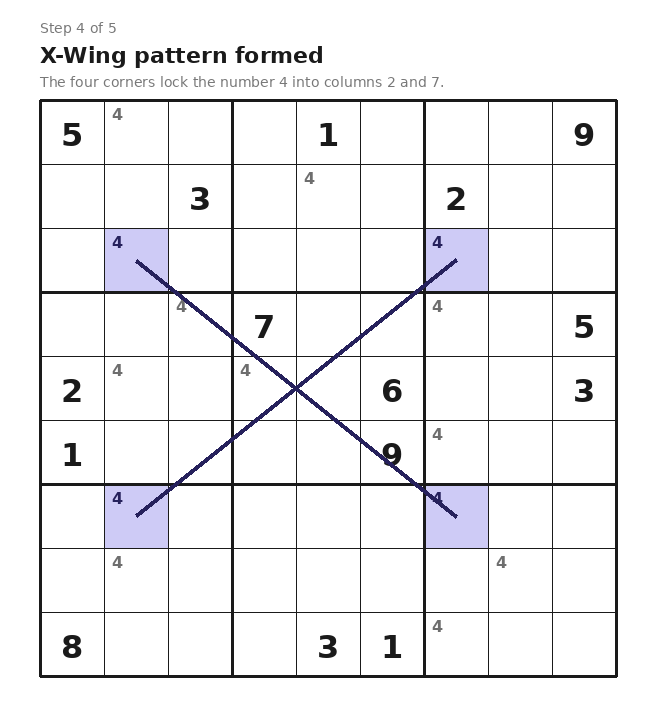
Step 5. After eliminating those candidates, look for naked singles or hidden singles that have now become available as a result. X-Wing often unlocks a chain of easier moves.
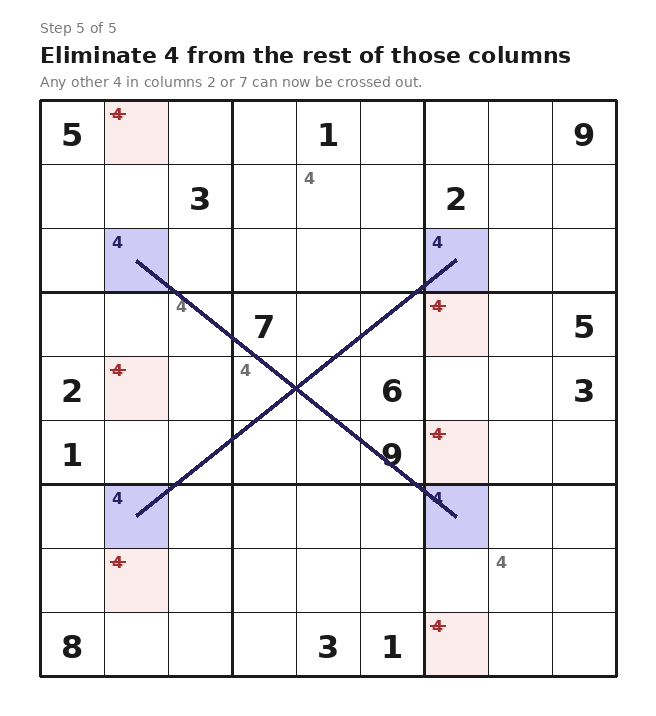
X-Wing Can Also Work on Columns
Everything above applies equally if you find the pattern in columns instead of rows. If a candidate appears in exactly two cells in each of two columns, and those cells align in the same two rows, you can eliminate that candidate from all other cells in those two rows. The logic is identical — just rotated.
Common Mistakes
Counting incorrectly. X-Wing only works if the candidate appears in exactly two cells per row (or column). If a row has three or more cells with that candidate, X-Wing does not apply to that row.
Eliminating from the wrong cells. You eliminate the candidate from other cells in the two columns — not from the four X-Wing cells themselves. Those four cells still hold the candidate.
Applying it too early. Always exhaust naked singles and hidden singles first. X-Wing is an advanced technique and you should not be looking for it until simpler methods are exhausted.
Practice Makes the Pattern Visible
X-Wing becomes much easier to spot with practice. The first few times you will need to work through it methodically. After applying it a dozen times you will start to notice the pattern quickly as you scan the grid.
For a deeper technical reference that includes variations like Finned and Sashimi X-Wings, see the comprehensive X-Wing guide on SudokuWiki.
Try a hard sudoku puzzle and put the X-Wing technique to the test. If you want to build up to it first, start with easy difficulty and work your way up. For more techniques at this level, explore the full sudoku strategies guide.