
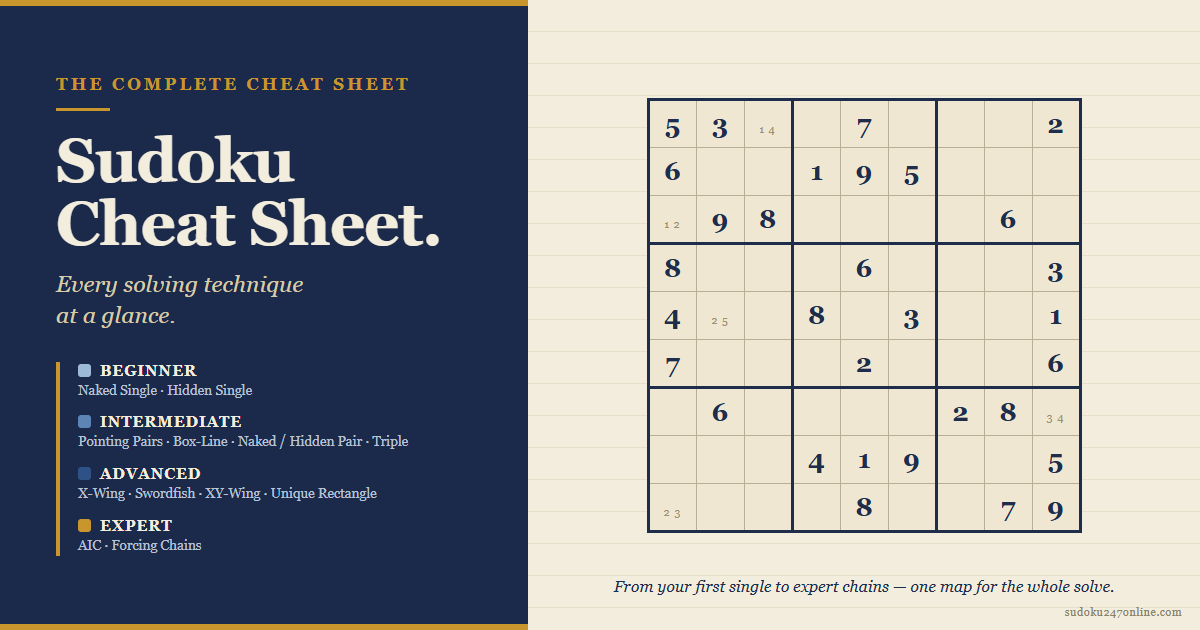
This is a complete reference guide to sudoku solving techniques, organised from beginner to advanced. Use it when you are stuck on a puzzle and need to identify which technique to try next, or as a learning guide to work through systematically. Each technique includes what it is, when to use it, and what it does.
How to Use This Guide
Work through techniques in the order listed. When you are stuck on a puzzle, start from the top and work down until you find a technique that applies. The techniques are ordered by difficulty — exhaust the simpler ones before attempting the advanced ones.
Level 1: Beginner Techniques
Naked Single
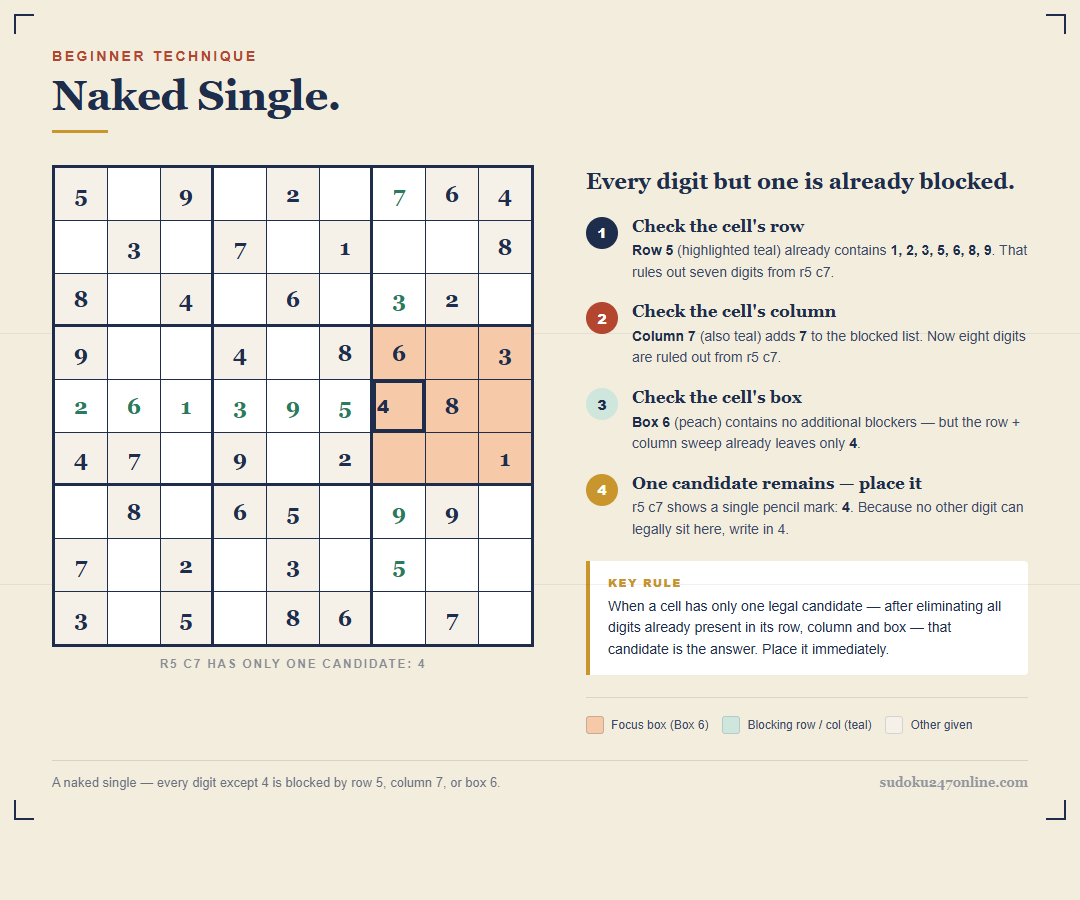
What it is: A cell with only one candidate remaining. When to use: Always check for these first, before anything else. What it does: The cell can only contain one number — place it immediately. How to find it: Scan every empty cell. If a cell has only one possible number given its row, column, and box constraints, that is a naked single.
Hidden Single
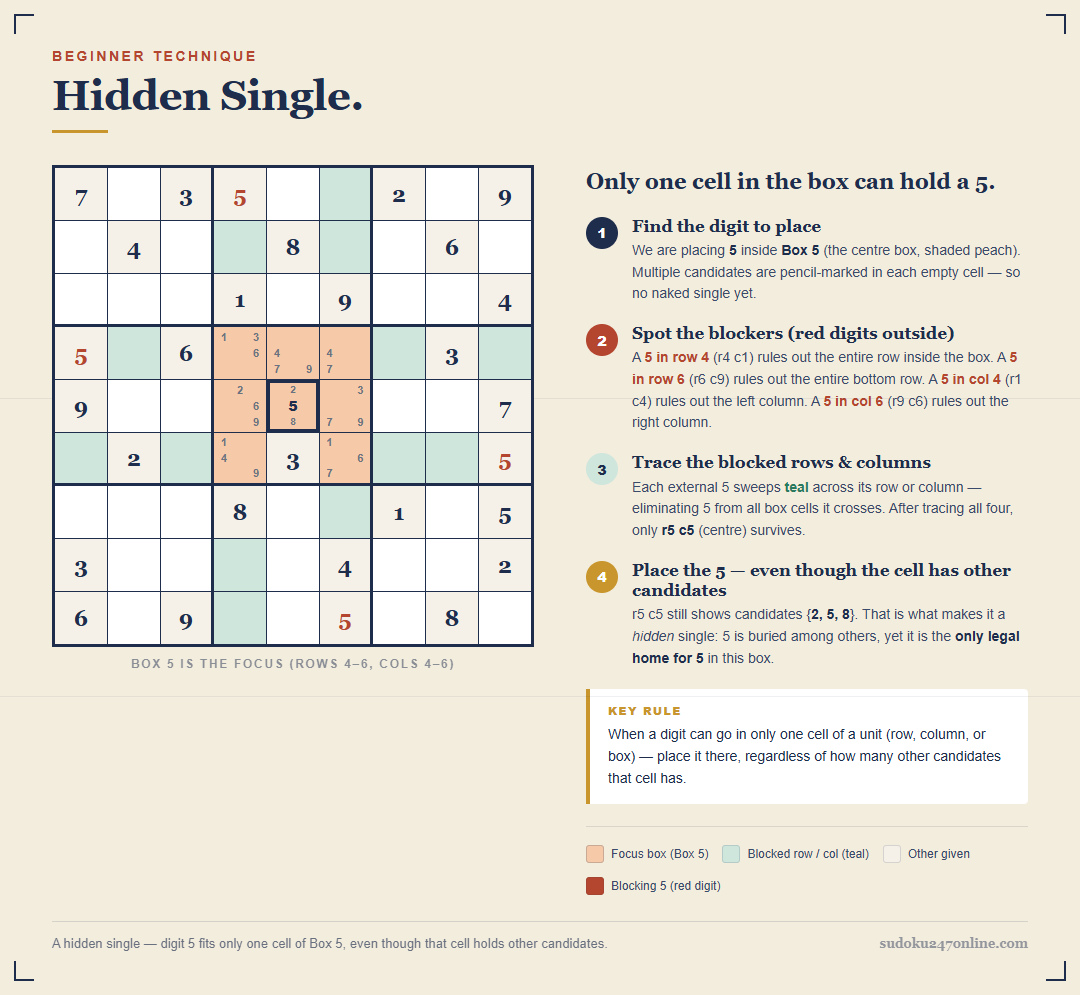
What it is: A number that can only go in one cell within a row, column, or box — even if that cell has other candidates. When to use: After exhausting naked singles. What it does: Lets you place a number in a cell that is not a naked single. How to find it: For each unplaced number in each unit, check how many cells can contain it. If only one cell is possible, place the number there.
Level 2: Intermediate Techniques
Pointing Pairs (Locked Candidates Type 1)
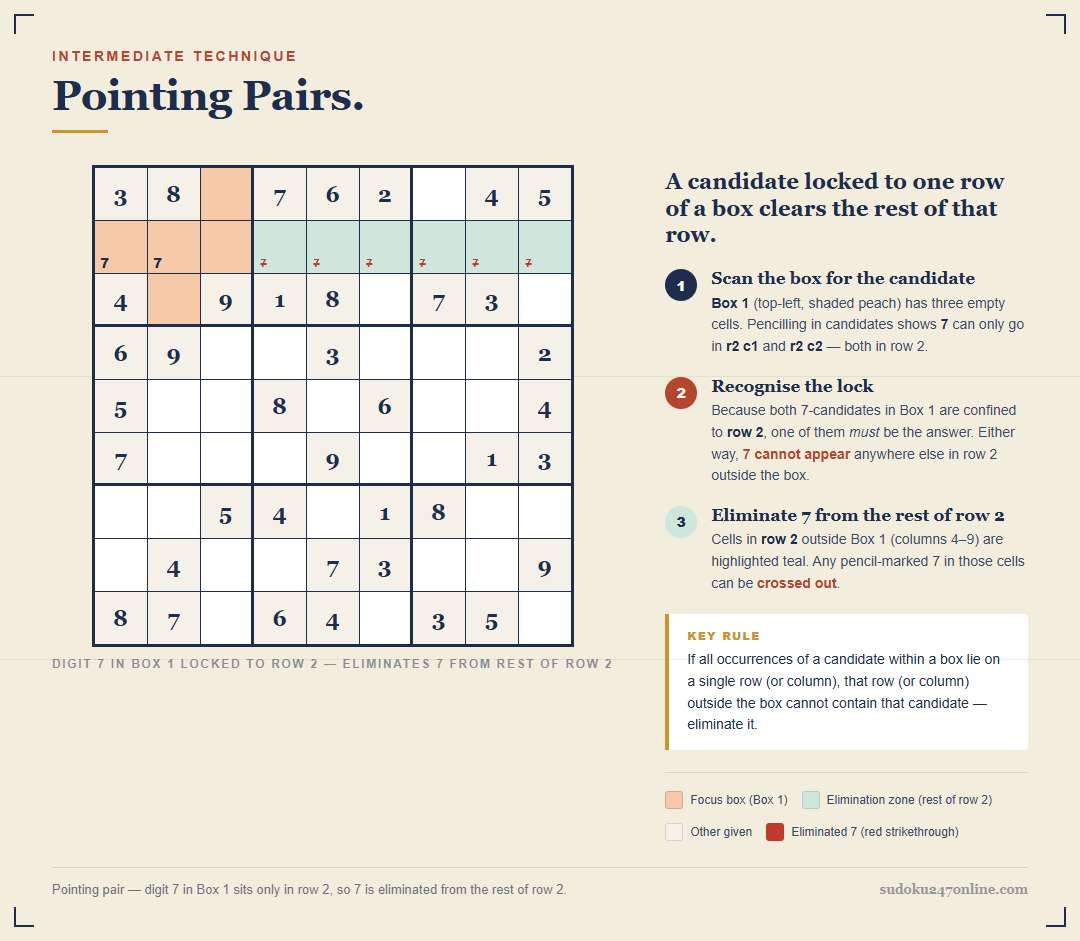
What it is: A candidate that only appears in one row or column within a 3×3 box. When to use: After naked and hidden singles are exhausted. What it does: Eliminates that candidate from the rest of the row or column outside the box. How to find it: For each number in each box, check whether all its candidate cells fall in the same row or column. If yes, eliminate it from other cells in that row or column.
Box-Line Reduction (Locked Candidates Type 2)
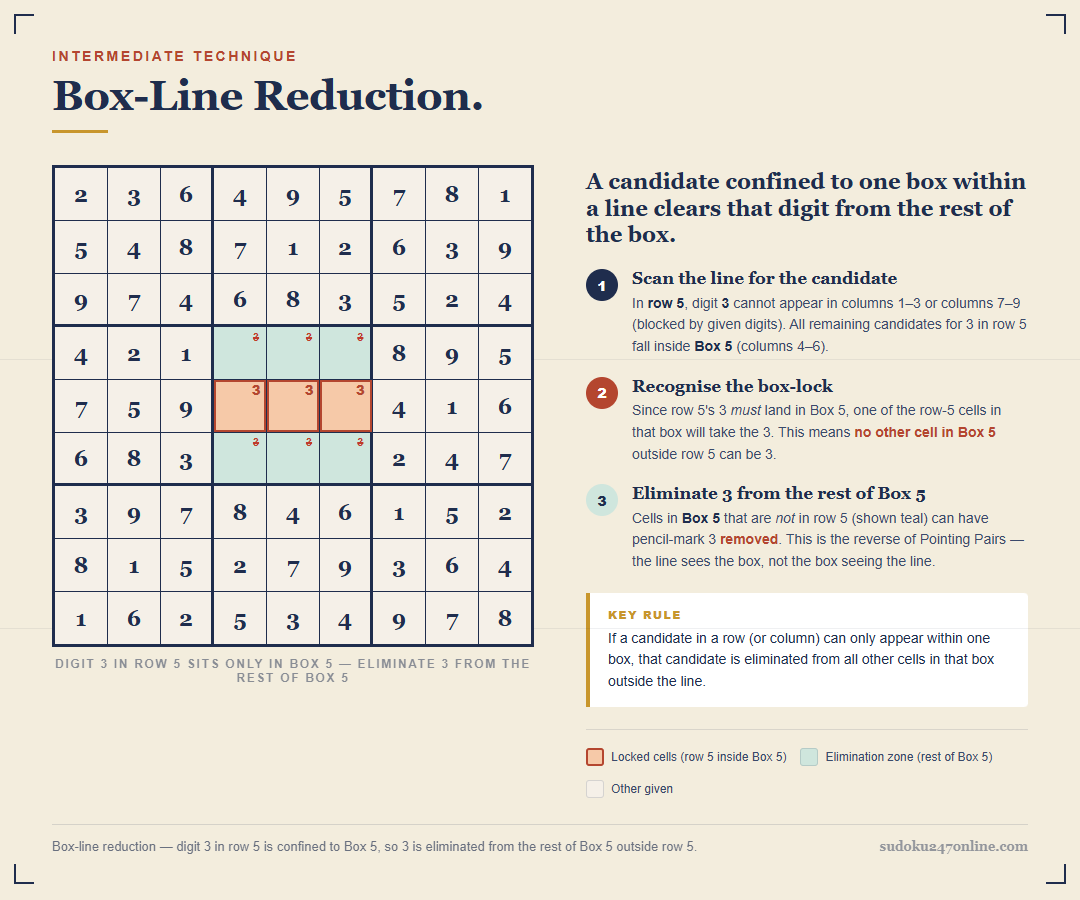
What it is: A candidate that only appears in cells belonging to the same 3×3 box within a row or column. When to use: After pointing pairs. What it does: Eliminates that candidate from the rest of the box. How to find it: For each number in each row and column, check whether all its candidate cells fall within the same 3×3 box. If yes, eliminate it from other cells in that box.
Naked Pair
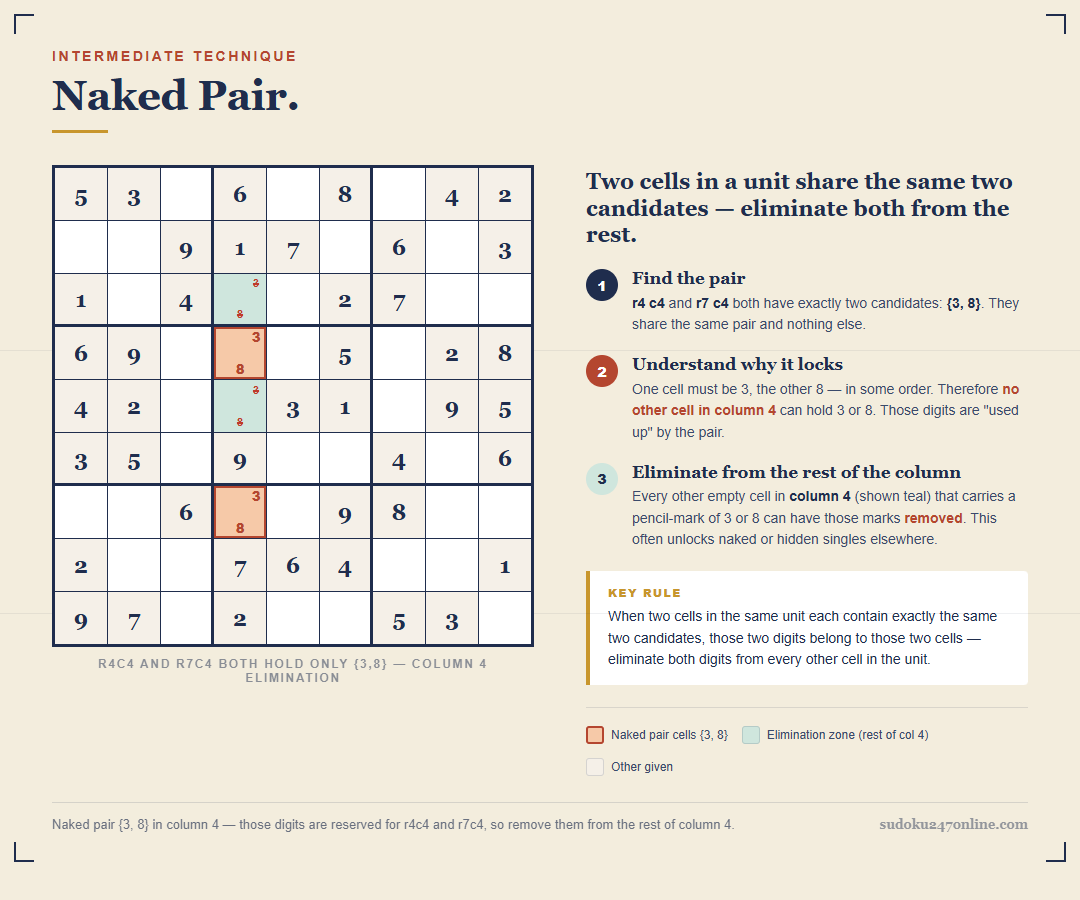
What it is: Two cells in the same unit that each contain exactly the same two candidates and nothing else. When to use: After locked candidates techniques. What it does: Eliminates those two numbers from all other cells in the same unit. How to find it: Look for cells with exactly two candidates. Check whether any other cell in the same row, column, or box has the identical pair.
Hidden Pair
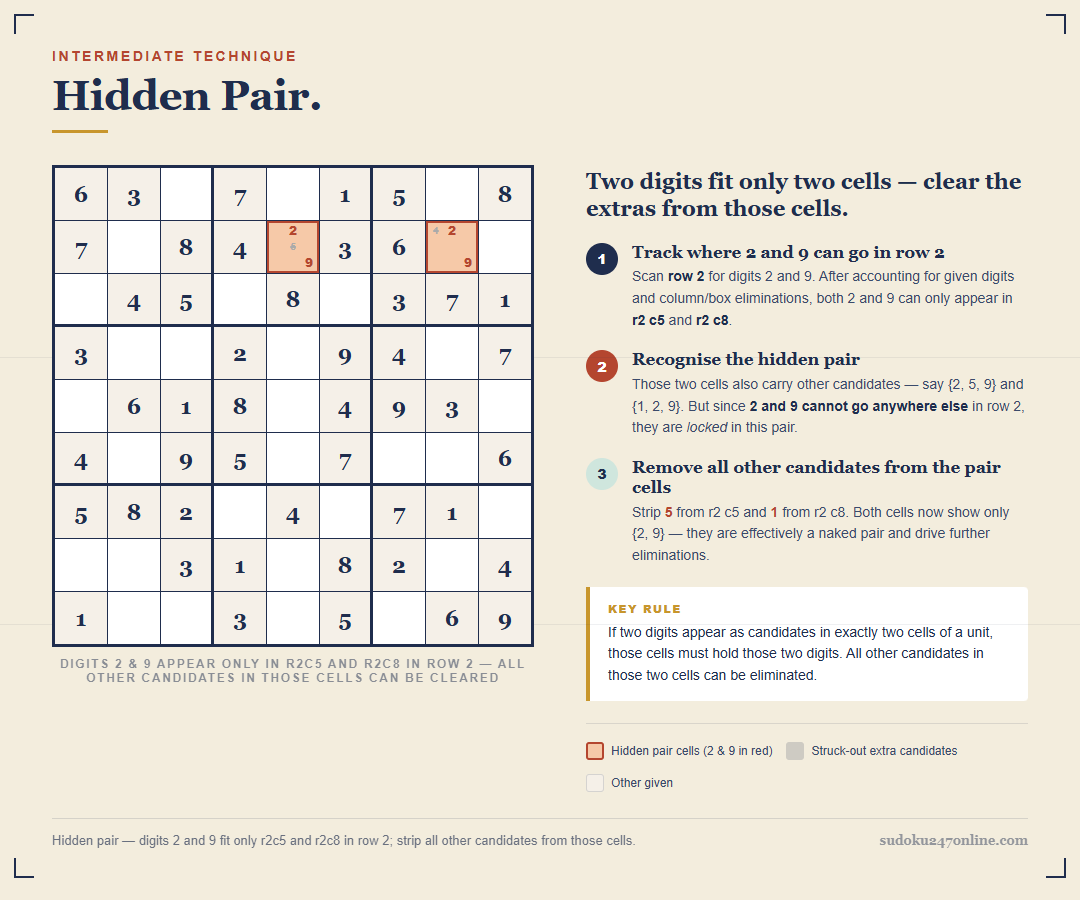
What it is: Two numbers that only appear as candidates in the same two cells within a unit, though those cells have other candidates too. When to use: After naked pairs. What it does: Eliminates all other candidates from those two cells. How to find it: For each unit, note which cells each unplaced number can go in. Look for two numbers that share exactly the same two cells.
Naked Triple
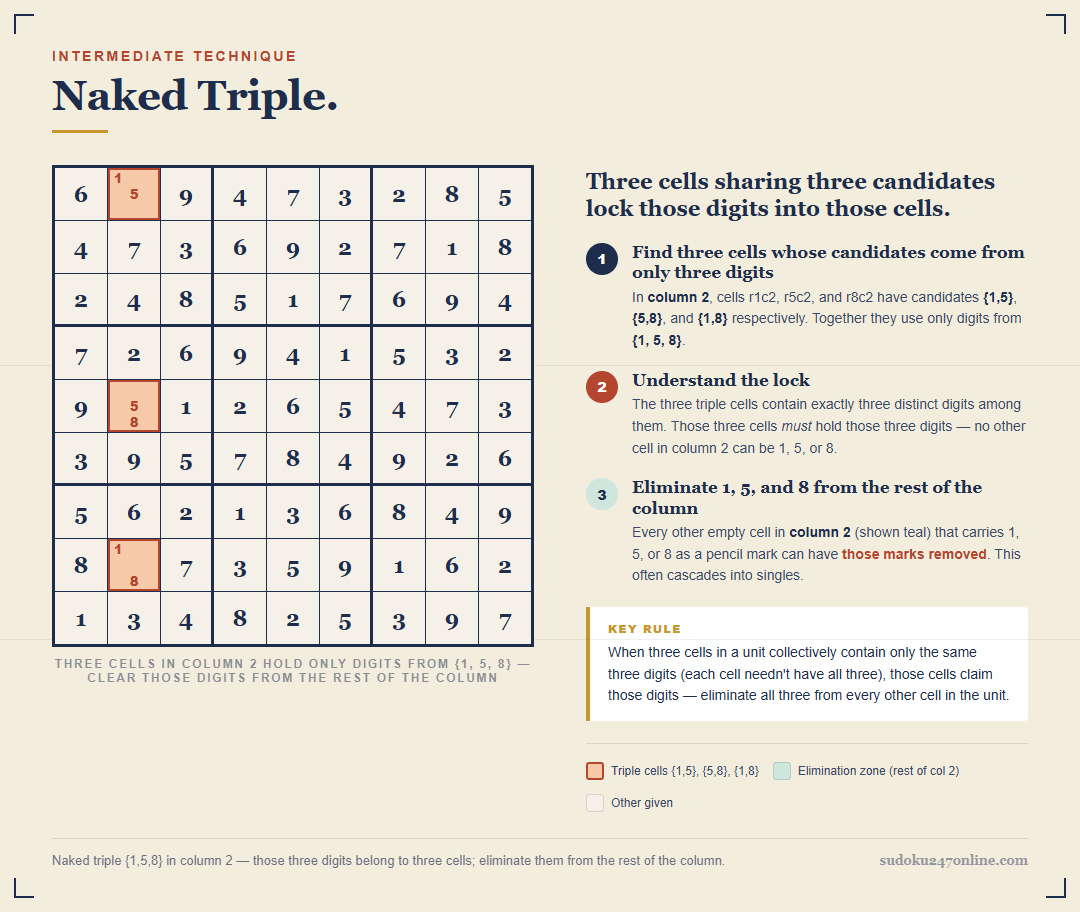
What it is: Three cells in the same unit whose combined candidates total exactly three numbers. When to use: After naked pairs. What it does: Eliminates those three numbers from all other cells in the unit. How to find it: Look for three cells in the same unit whose candidates are all drawn from the same pool of three numbers (e.g. 1,4,7 across three cells in various combinations).
Hidden Triple
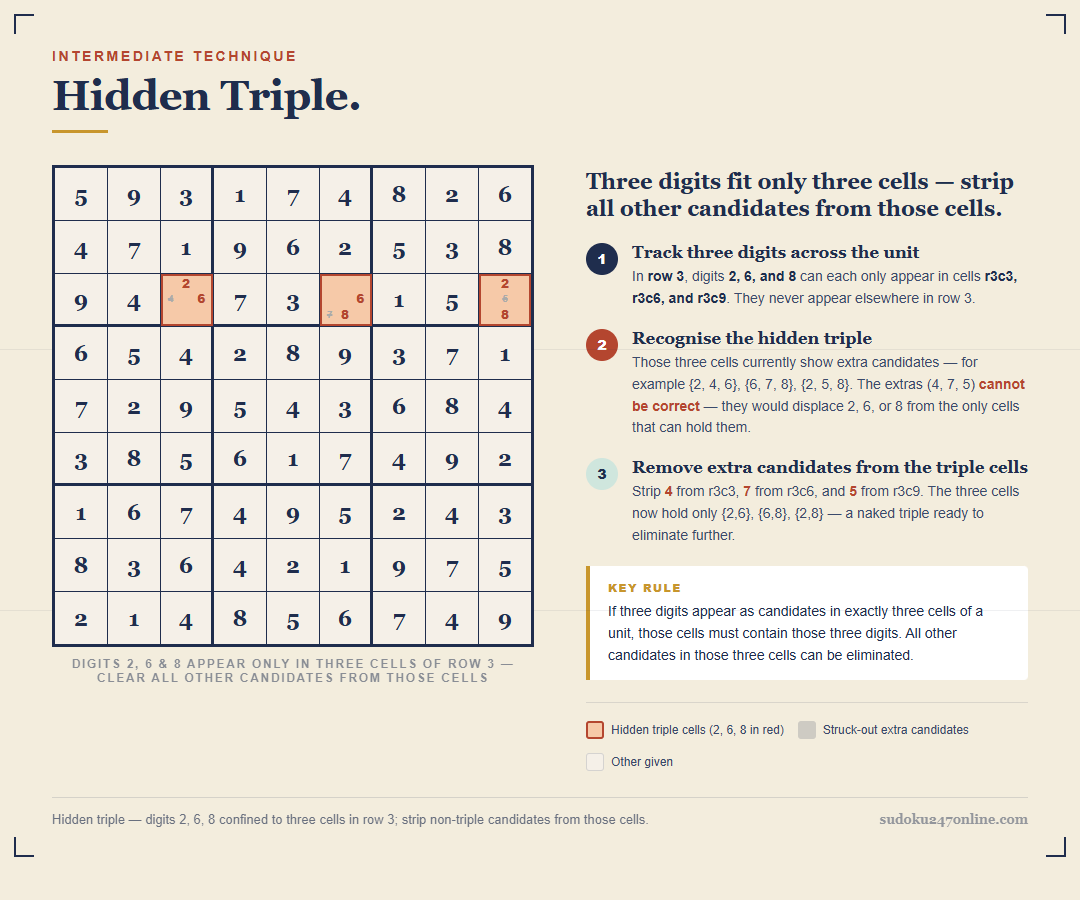
What it is: Three numbers that only appear in the same three cells within a unit. When to use: After hidden pairs. What it does: Eliminates all other candidates from those three cells. How to find it: Same as hidden pair but with three numbers and three cells.
Level 3: Advanced Techniques
X-Wing
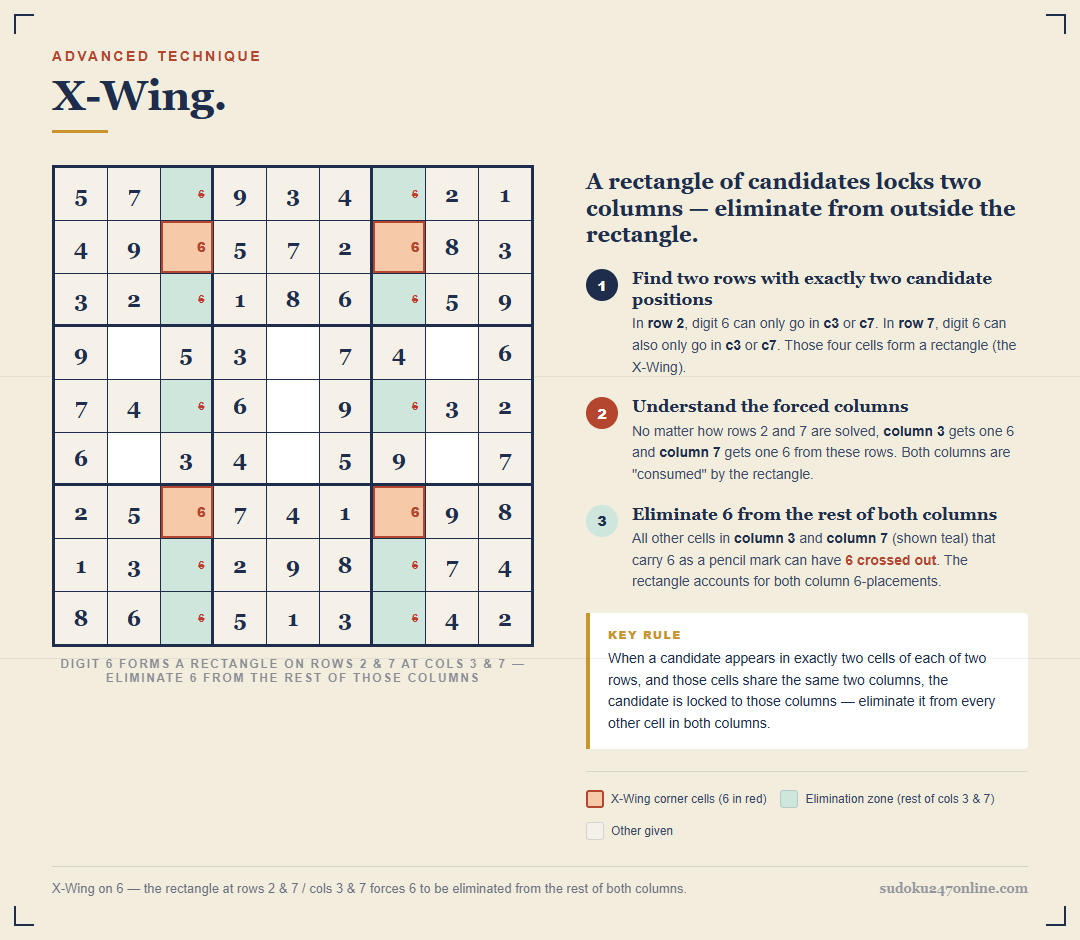
What it is: A candidate that appears in exactly two cells in each of two rows, with those cells in the same two columns. When to use: When pairs and locked candidates are exhausted. What it does: Eliminates that candidate from all other cells in those two columns. How to find it: For each number, scan rows looking for rows where the number only appears in two cells. Note the columns. Find two rows with the same two columns. See the full X-Wing guide.
Swordfish
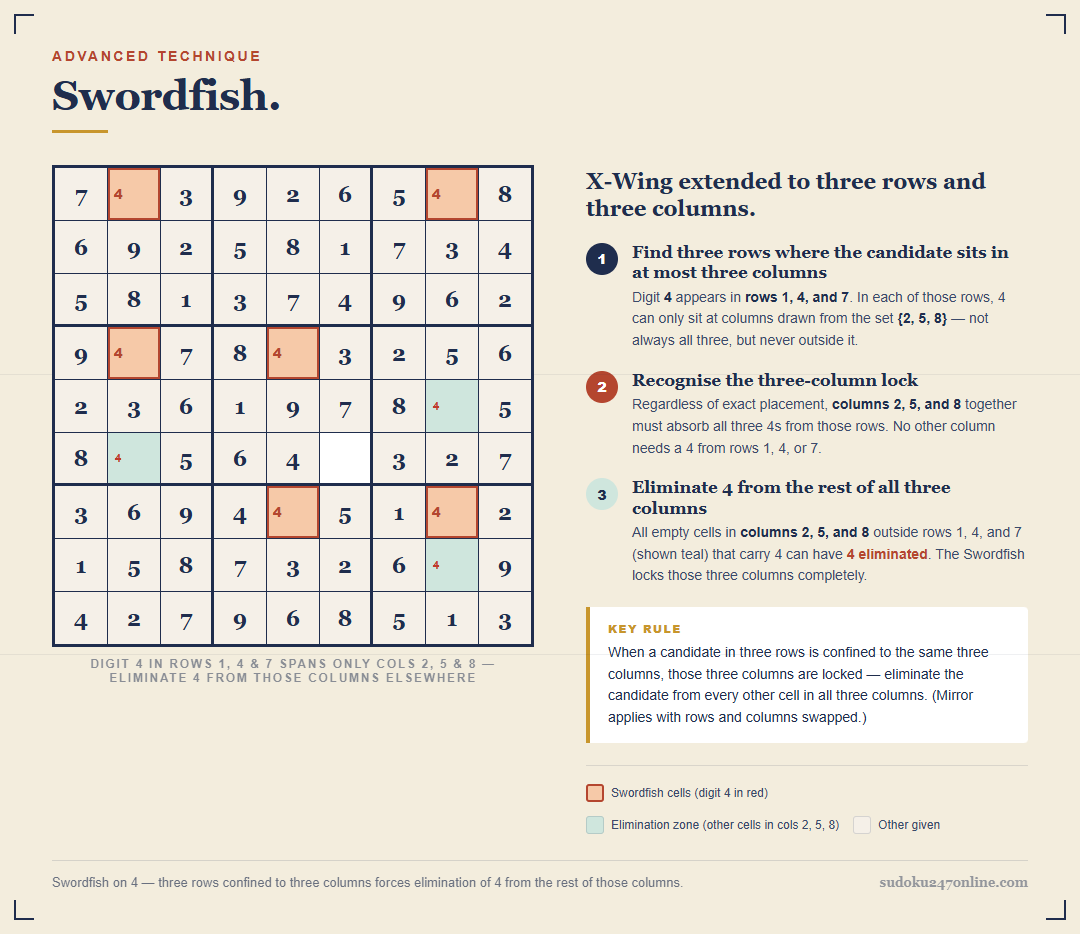
What it is: The three-row version of X-Wing. A candidate appears in 2-3 cells in each of three rows, with all cells confined to the same three columns. When to use: After X-Wing. What it does: Eliminates that candidate from all other cells in those three columns. How to find it: Same logic as X-Wing extended to three rows and three columns.
XY-Wing
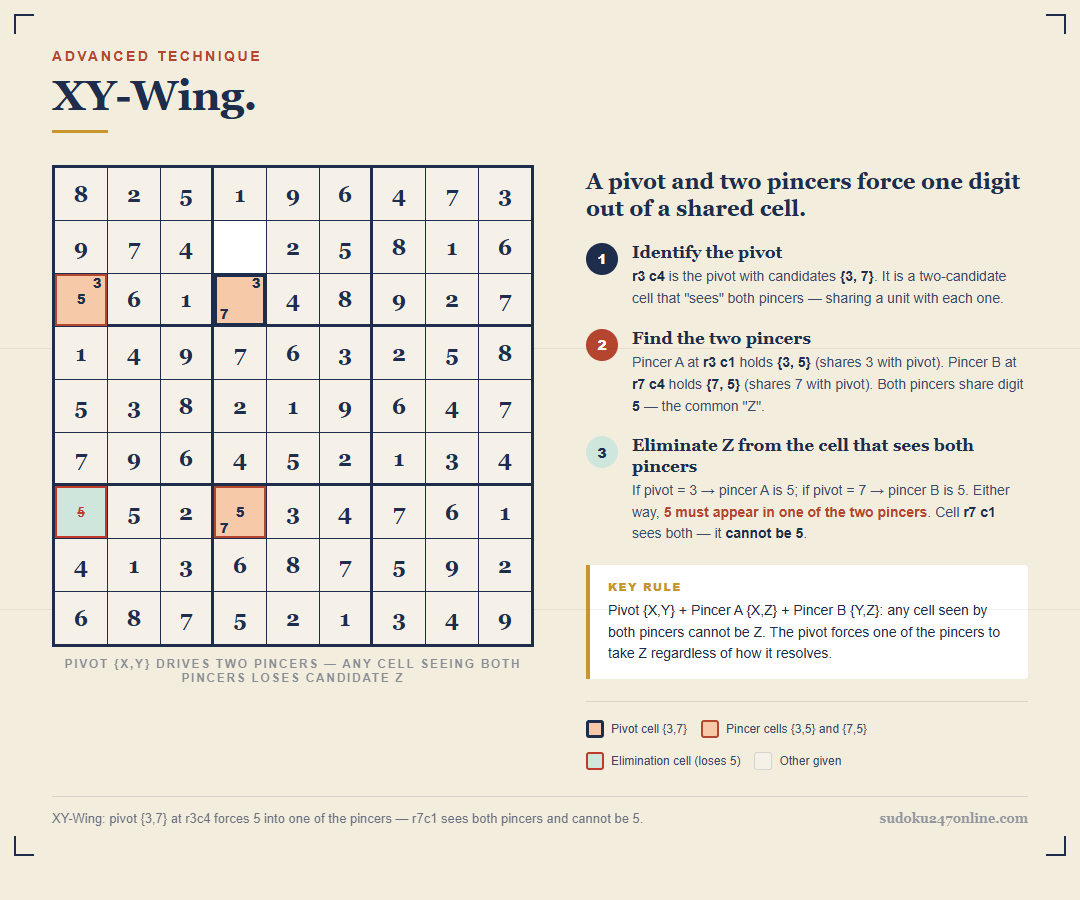
What it is: Three cells (pivot and two pincers) arranged so that no matter which value the pivot takes, a specific candidate is eliminated from cells that see both pincers. When to use: When row/column pattern techniques are exhausted. What it does: Eliminates a specific candidate from cells that see both pincer cells. How to find it: Find a cell with exactly two candidates (the pivot). Find two other cells, each seeing the pivot, each sharing one candidate with it. If their combined non-shared candidates are the same number, that number can be eliminated from any cell that sees both pincers.
Unique Rectangle
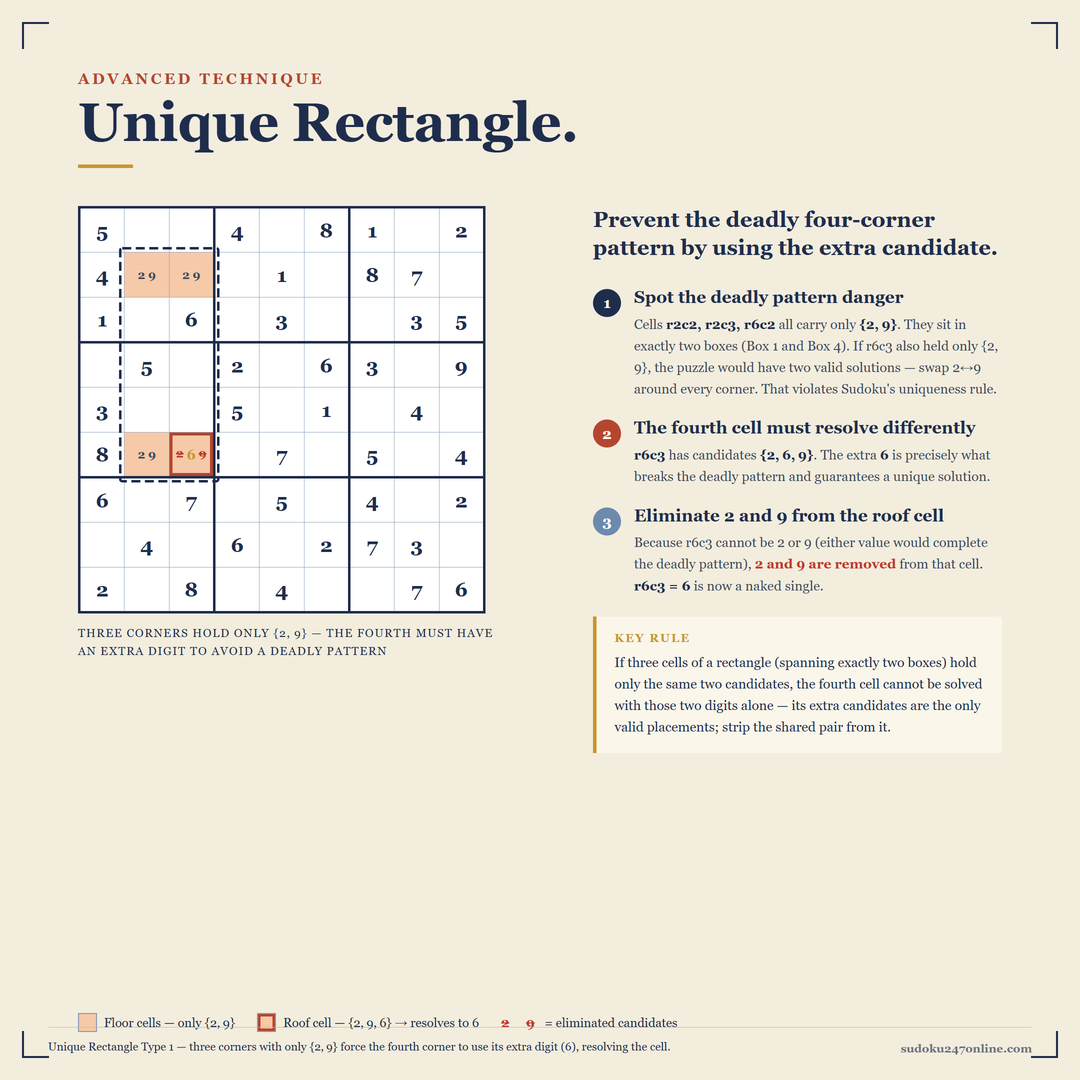
What it is: A pattern of four cells forming a rectangle across two boxes that would create two solutions if left unresolved. When to use: When standard candidate elimination is stuck. What it does: Exploits the fact that a valid puzzle has exactly one solution to force eliminations. How to find it: Look for four cells forming a rectangle (two rows, two columns) where two or more cells share the same two candidates. Various types (1-5) offer different elimination possibilities.
Level 4: Expert Techniques
Alternating Inference Chains (AIC)
What it is: A chain of cells linked by strong and weak inference relationships, alternating between the two. When to use: When all pattern-based techniques fail. What it does: Can eliminate candidates or force placements based on logical consequences traced through a long chain. How to find it: Requires systematic chain-building from a starting candidate, following strong links (where a number must be in one of two positions) and weak links.
Forcing Chains
What it is: Assuming a candidate is true or false and tracing the logical consequences until a contradiction or certainty is reached. When to use: As a last resort when other techniques fail. What it does: Forces a placement or elimination when simpler logic cannot. Note: Some purists consider this equivalent to trial and error. It is logically valid but computationally intensive.
Quick Reference: Technique Decision Tree
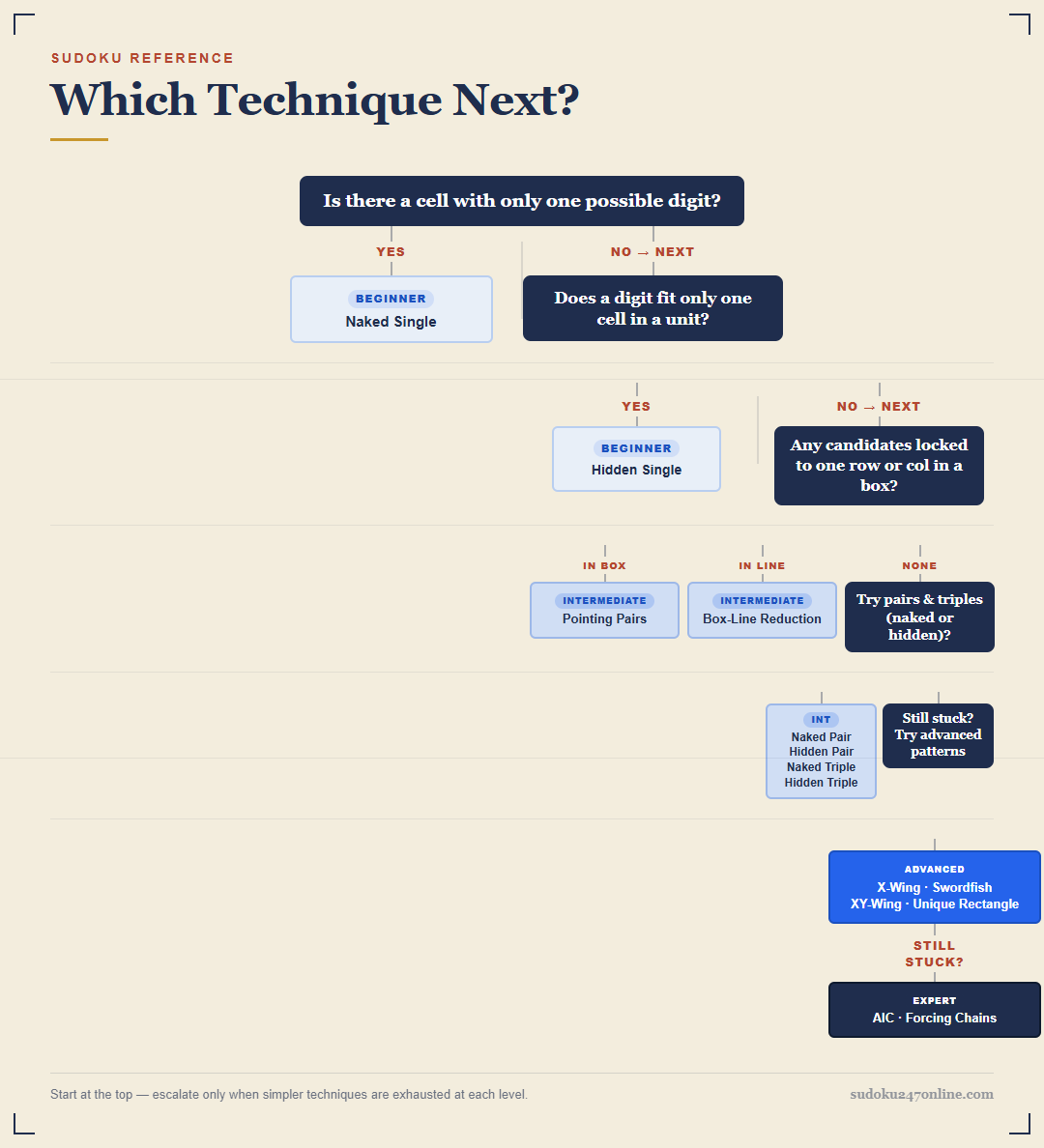
Stuck on a puzzle? Work through this in order:

1. Naked singles → any cells with one candidate?
2. Hidden singles → any number with one position in a unit?
3. Pointing pairs → any candidates confined to one row/column in a box?
4. Box-line reduction → any row/column candidates confined to one box?
5. Naked pairs → any two cells with identical two-candidate sets?
6. Hidden pairs → any two numbers sharing exactly two cells in a unit?
7. Naked/hidden triples → extend pair logic to three cells/numbers
8. X-Wing → any number with two-cell rows sharing the same two columns?
9. Swordfish → extend X-Wing to three rows
10. XY-Wing → any pivot cell with two candidates and matching pincers?
11. Unique Rectangle → any rectangle pattern with repeated candidates?
12. AIC / Forcing chains → last resort
If none of these apply, check your candidates for errors. A stale candidate — one that should have been eliminated but was not — is the most common cause of a genuine impasse.
Technique Reference by Difficulty Level
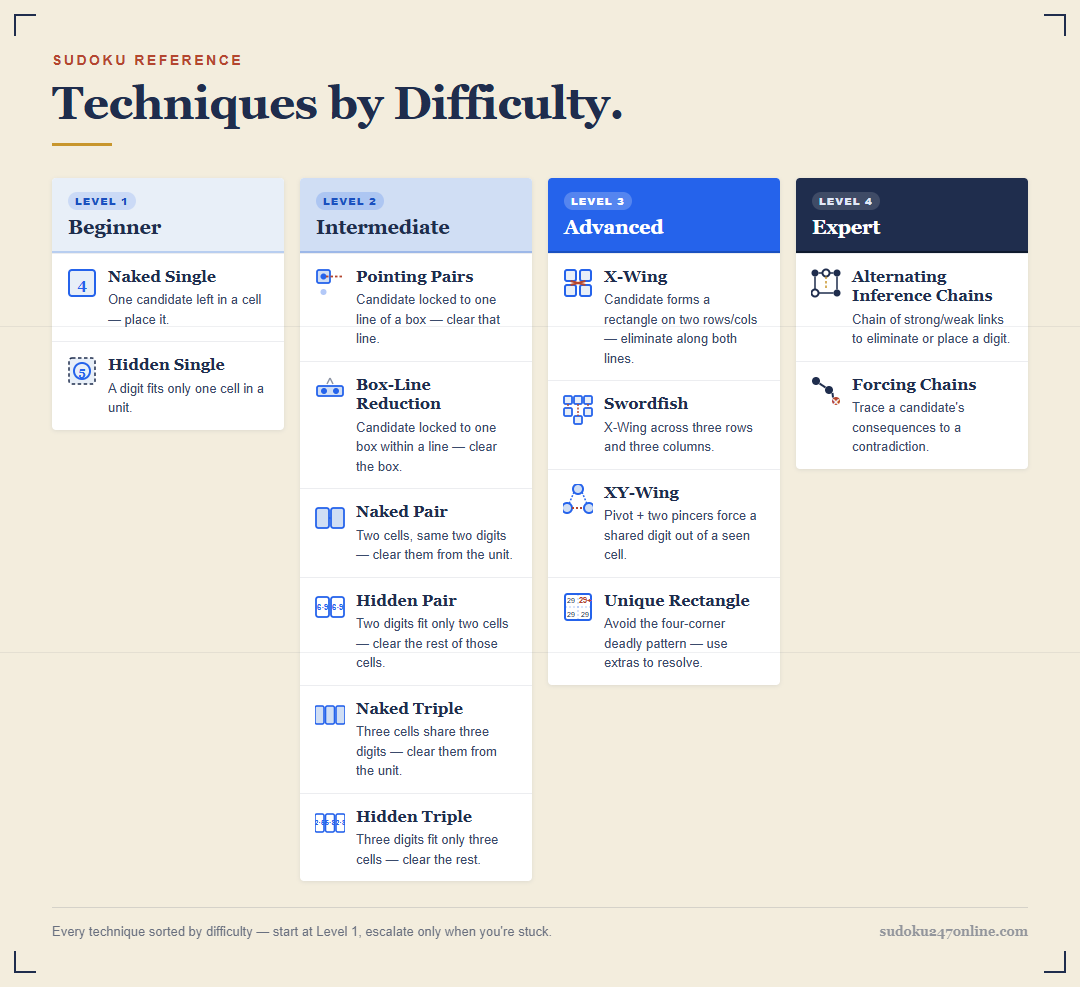
Easy puzzles: Naked singles, hidden singles Medium puzzles: Above + pointing pairs, box-line reduction Hard puzzles: Above + naked pairs, hidden pairs, X-Wing Expert puzzles: Above + swordfish, XY-Wing, unique rectangle, chains
For detailed guides on individual techniques, read about candidate mode, hidden pairs, X-Wing, advanced sudoku tips, and Snyder notation. Browse all guides in the sudoku strategies section.
For the mathematics behind sudoku difficulty and technique classification, the World Puzzle Federation and competitive sudoku community have documented the full hierarchy of techniques in detail.
Try an expert sudoku puzzle and work through this cheat sheet from the top. Play hard sudoku if you want to practise the mid-level techniques before attempting expert.