
The best number puzzles for kids are the ones that feel like play while quietly building real math skills — counting, ordering, logic, and spotting patterns. Pick a puzzle for the skill you want to grow, keep it short and low-pressure, and let your child enjoy the small win at the end. Below is a calm, no-fuss guide to the main types of number puzzles, what each one builds, and why a gentle sudoku grid makes such a good first logic puzzle.
What are number puzzles for kids?
Number puzzles for kids are simple games where a child works with numbers to reach an answer — filling a missing number, finishing a sequence, or arranging digits so a rule comes out right. There is no rushing and no scorekeeping. Your child reads the clues, thinks it through, and feels the satisfaction of getting it to work.
What makes them special is that the math hides inside the fun. A child solving a puzzle is counting, comparing, and reasoning — but it feels like a game, not a worksheet. That matters, because young children tend to learn math best through hands-on play and exploration rather than drilling — making sense of numbers in their own minds, at their own pace.
What number puzzles build
Different puzzles grow different skills, so it helps to know what you are reaching for. Here is the honest version — these puzzles give your child meaningful practice, not a guarantee of grades.
- Counting and number sense. Matching a digit to a quantity, or counting up to a missing number, builds the early “feel” for how big numbers are and how they relate. Number sense develops early and is one of the strongest signs of later success in math.
- Ordering and sequencing. Finishing a sequence (2, 4, 6, …) teaches your child to see what comes next and why — the start of pattern thinking.
- Logic and reasoning. Puzzles with rules ask a child to follow the rule, rule out what cannot work, and decide what must be true. That is real deduction, in a kid-sized package.
- Pattern spotting. Repeating shapes, sums, and arrangements train the eye to notice structure — a skill that shows up everywhere in math later on.
- Focus and patience. Sticking with one quiet problem until it clicks is its own gentle lesson, and the finish gives a real boost to confidence.
Types of number puzzles
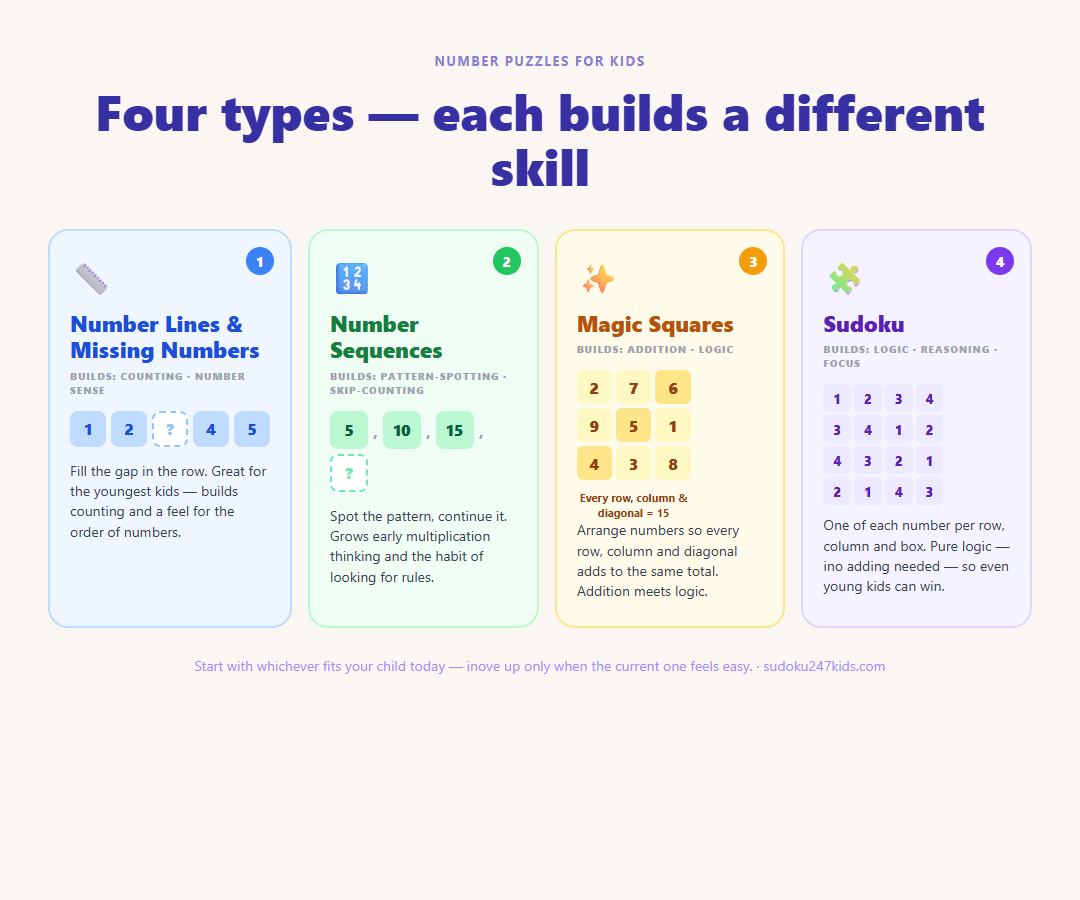
You do not need fancy materials. A handful of simple puzzle types covers most of what a young child needs, and each one leans on a slightly different skill.
- Number lines and missing-number puzzles. A row of numbers with a gap to fill. Great for the youngest kids — it builds counting and a sense of order.
- Number sequences. A pattern to continue, like 5, 10, 15, ___. These grow pattern-spotting and early multiplication thinking.
- Magic squares. A small grid where every row, column, and diagonal adds up to the same total. A friendly way to practice addition and a little logic at once.
- Sudoku. A grid where each row, column, and box holds a set of numbers with no repeats. Pure logic — no adding needed — which is why it suits kids who are still building their number facts.
Start with whichever fits your child today, and move up only when the current one feels easy. The goal is a happy “I did it,” not a struggle.
Sudoku: the keystone number-logic puzzle
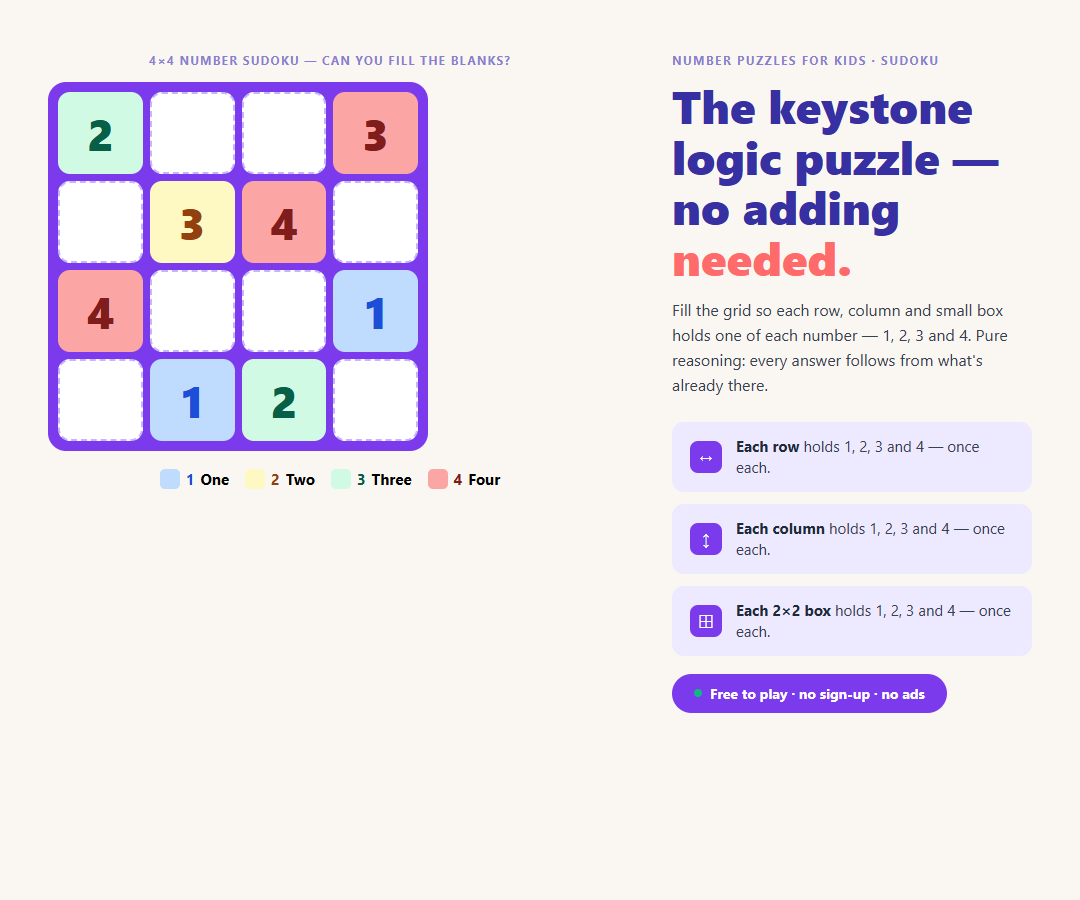
If you pick just one number puzzle to grow with your child, make it sudoku. It is the keystone number-logic puzzle: the rule is tiny — fill the grid so each row, column, and box has one of each number — but the thinking runs deep. And because you never have to add or subtract, even a child who is still learning their numbers can win at it.
The trick is starting small. A free 4×4 number sudoku uses only the numbers 1 to 4 in a four-by-four grid, so the logic is gentle and the wins come quickly. For pre-readers — or any child who is not ready for digits yet — picture sudoku swaps the numbers for friendly shapes and animals, teaching the exact same “one of each, no repeats” reasoning without a single number on the page.
Both are free to play right in the browser, with no ads and no timers — just a calm grid your child can think through at their own pace. When the 4×4 grid feels easy, a 6×6 grid is the natural next step. Want something to take to the table or the car? You can print kid-friendly sheets from the printable sudoku for kids page.
Using number puzzles in the classroom
Number puzzles earn their place in a classroom because they are quiet, self-paced, and easy to match to a skill. A teacher who wants ordering practice can reach for number lines; one who wants logic can reach for sudoku. They make calm early-finisher tasks, gentle warm-ups, or a five-minute brain break that still keeps young minds working.
Sudoku works especially well for a whole class because it scales. The same puzzle idea fits a 4×4 grid for younger learners and a 6×6 grid for those ready to stretch, so no child is bored and no child is lost. If you teach, the sudoku for the classroom page gathers the grids and printables in one place, with no sign-up needed.
Want the bigger picture of which puzzles suit which ages? Our guide to the best logic puzzles for kids by age lays out a friendly progression from pre-readers to confident solvers.
Frequently asked questions
What are the best number puzzles for young kids?
For the youngest children, start with missing-number puzzles and number lines, then move to picture sudoku and a 4×4 number sudoku. They build counting, ordering, and logic without needing any addition.
Do number puzzles really help with math?
They give children meaningful, playful practice with counting, patterns, and logic — the foundations of number sense that support later math. They are a helpful habit, not a shortcut, and they work best alongside everyday math talk and play.
What is the difference between a number puzzle and a math puzzle?
A math puzzle usually asks your child to calculate — to add, subtract, or multiply. A number puzzle is broader: many, like sudoku, are pure logic and need no arithmetic at all, which makes them friendly for kids still learning their number facts.
Are number puzzles good for the classroom?
Yes. They are quiet, self-paced, and easy to match to a skill, which makes them ideal for warm-ups, brain breaks, and early-finisher tasks. Grids like 4×4 and 6×6 sudoku scale to different levels so a whole class can take part.