
No. You never have to guess in sudoku. A proper puzzle has exactly one solution, and that solution can always be reached by logic alone. So if you feel stuck and tempted to guess, it almost always means there’s a move on the board you haven’t spotted yet.
That’s the good news, and it’s worth holding onto. Hard sudoku can feel like it’s daring you to roll the dice. It isn’t. Below we’ll walk through why a well-made puzzle never needs a guess, exactly what to do when you’re stuck, and the one honest exception people argue about. By the end you’ll have a clear plan for solving difficult sudoku without ever leaving it to luck.
The short answer: no, you don’t have to guess
A correctly made sudoku has one — and only one — solution, and every step toward it can be justified by logic. That’s the definition of a “proper” or “well-formed” puzzle. If a puzzle had two valid answers, it would be broken, and any reputable source (including this site) would never publish it.
So when you hit a wall, the honest read is simple: a move you can prove is sitting somewhere on the grid — you just haven’t found it. Guessing isn’t a missing skill the puzzle demands of you. It’s a sign to slow down and look again.
Why a proper puzzle never needs guessing
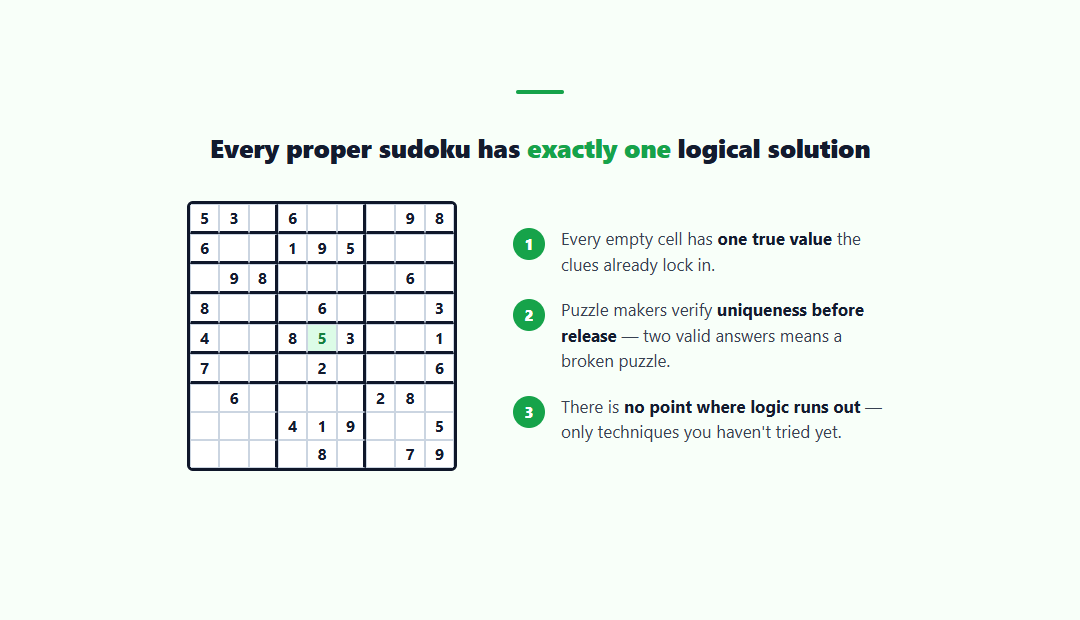
The reason comes down to that single, guaranteed solution. Because there is exactly one answer, every empty cell has one true value that the clues already lock in — even if the chain of reasoning to get there is long. There is no point where the puzzle “runs out of logic” and forces you to flip a coin.
This isn’t just a nice idea; it’s baked into how puzzles are built. A puzzle maker tests every grid to confirm it has a unique solution before it’s released. Mathematicians have studied this closely — a 9×9 grid needs a minimum number of clues to guarantee a single answer, and well-formed puzzles are constructed to clear that bar. You can read more about why every sudoku has a unique solution in the basics, and the math behind it is laid out in this Cornell University write-up on the mathematics of sudoku.
The takeaway: if the answer is fixed and reachable by logic, then guessing is never required. It might be a shortcut some people take — but it’s never the only road.
What to do instead of guessing

When you’re stuck, work this escalation in order. Each step looks harder for moves than the last, so you exhaust the easy logic before reaching for anything fancy.
- Re-scan the board. Pick a digit and check every row, column, and box for it. Stuck feelings are often just a single, obvious placement you skimmed past.
- Fill in your pencil marks. Write the candidate numbers into each empty cell. You can’t spot a pattern you haven’t written down — see how givens and candidates work if this is new to you.
- Look for naked and hidden singles. A cell with only one candidate, or a digit that fits only one cell in a unit, is a free move. Master the naked single and hidden single first — they unlock most of any puzzle.
- Use locked candidates (pointing pairs). When a digit in a box is confined to one row or column, you can eliminate it elsewhere. Learn the pointing pair.
- Find pairs. Two cells in a unit sharing the same two candidates lock those digits out of every other cell in that unit. Both the naked pair and hidden pair open up grids that feel frozen.
- Step up to advanced techniques. Triples, X-Wings, and beyond. The full ladder lives in the sudoku technique library — there’s always a next tool when the current one runs dry.
Nine times out of ten, one of these steps breaks the puzzle open. The wall you hit wasn’t the end of the logic — it was the edge of the technique you happened to be using.
When “guessing” is really a technique
Here’s the honest nuance most articles skip. On a handful of extreme puzzles, even expert solvers reach a point where no single deduction is visible. At that stage, they may pick a candidate, follow its consequences, and see whether it forces a contradiction. If it does, that candidate is eliminated by proof.
That looks like guessing, but it isn’t. It’s a structured method — solvers call it bifurcation, trial chains, or (limited to one digit) Nishio. The key difference: a random guess just hopes you’re right, while a trial chain proves something either way. If the candidate leads to a contradiction, you’ve logically ruled it out. That’s deduction wearing a disguise, and it’s exactly what forcing chains formalise.
So even the scariest puzzles don’t ask you to gamble. They ask you to follow a logical thread to its end. Reputable puzzle references agree — guessing is a fallback for missing technique, not something a good puzzle requires (Sudoku of the Day’s guide to guesswork makes the same point).
Hard isn’t the same as ambiguous
It’s easy to mix up two very different ideas: a puzzle being hard and a puzzle being ambiguous. They’re not the same thing.
Difficulty is about which techniques you need to find the answer. An “easy” puzzle yields to singles. A “diabolical” one might demand X-Wings or chains. But both have one fixed solution. Ambiguity — two or more valid answers — is something else entirely, and it only happens in broken puzzles. A well-made hard puzzle is never a guessing game; it’s a longer logic problem with a single right answer waiting at the end.
Build the skills to never guess again
Every time you “had to guess,” what really happened is you ran out of techniques — not logic. The fix is to add more tools to your kit, so the next wall has a door.
Start with the elimination basics — naked and hidden singles — then climb the ladder through pairs, locked candidates, and the advanced patterns. The full technique library walks you through each one with worked examples, ordered roughly from gentlest to toughest. Work through them and you’ll feel that “I have to guess” instinct quietly disappear, replaced by “let me check one more pattern.” That’s how you solve hard sudoku without guessing — for good.
Frequently asked questions
Are there sudokus with more than one solution?
Not properly made ones. By definition, a valid sudoku has exactly one solution. A grid with two or more answers is a broken puzzle, and any reputable publisher tests for uniqueness before releasing it. If you ever find a puzzle with multiple solutions, it was made incorrectly.
Is trial and error the same as guessing?
Not quite. A pure guess just hopes you picked right. A trial chain (also called bifurcation or Nishio) follows a candidate’s consequences until it either confirms the value or hits a contradiction that rules it out by proof. That’s structured deduction, not luck — and on most puzzles you won’t need it at all.
What’s the hardest technique I’ll actually need?
It depends on the puzzle’s difficulty. Most everyday puzzles need nothing beyond singles, pairs, and pointing pairs. Harder grades may call for X-Wings, Swordfish, or chains. The technique library is ordered by difficulty, so you can stop at the level your puzzles require and add more as you take on tougher ones.